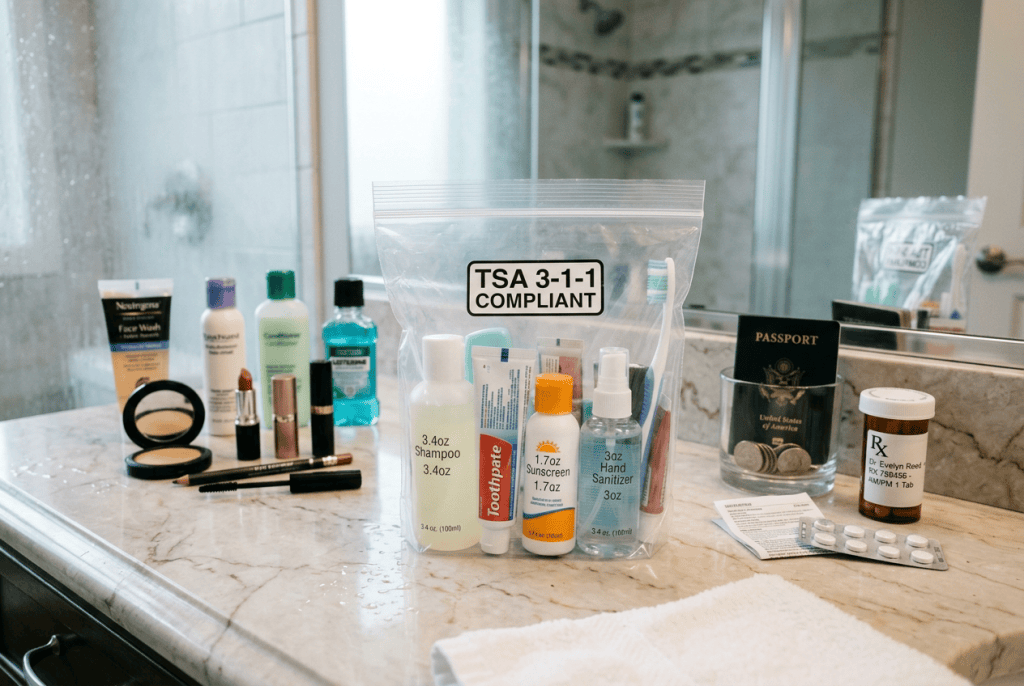
Makeup, deodorant, wipes, medications, and everything else you need to know about the TSA liquids rule.
If you’ve ever stood in front of your bathroom counter wondering whether your mascara, deodorant, or makeup wipes need to go into that tiny clear liquids bag, you’re definitely not alone! Even frequent travelers can find TSA’s liquids rules a little confusing, especially when it comes to makeup and toiletries.
The good news is that quite a few things you might assume are liquids actually aren’t, so you can save valuable space in that quart-sized bag.
Here’s a quick guide to what needs to go in your liquids bag, what doesn’t, and a few exceptions to know before your next flight.
First, What Is TSA’s 3-1-1 Liquids Rule?
If you’re flying from a U.S. airport with carry-on luggage, TSA’s 3-1-1 rule applies to liquids, gels, creams, pastes, and aerosols.
Here’s what 3-1-1 means:
- 3.4 ounces (100 ml): The maximum container size for each liquid product.
- 1 quart-sized bag: All your regular liquids must fit into one clear, resealable, quart-sized bag.
- 1 bag per passenger: Each traveler is allowed one liquids bag.
Remember, it’s the container size that matters, not how much product is left inside. That half-empty 6-ounce bottle of shampoo still won’t make it through security in your carry-on.
What Counts as a Liquid for TSA?
<escape>These items must go into your clear quart-sized liquids bag if you’re taking them through security in your carry-on (unless they qualify for an exemption):</escape>
- Shampoo and conditioner: Including liquid and gel formulas.
- Body wash and shower gel: Any liquid or gel-based product.
- Toothpaste: Yes, even toothpaste counts as a liquid!
- Liquid foundation: Including tinted moisturizers, BB creams, and CC creams.
- Concealer: Liquid and cream formulas.
- Mascara: Regular and waterproof mascara.
- Lip gloss and liquid lipstick: Including lip oils and liquid lip stains.
- Cream and gel blush: Including liquid bronzers and highlighters.
- Liquid eyeliner: Including gel eyeliner in pots.
- Moisturizers and face creams: Including eye creams and serums.
- Sunscreen: Liquid, cream, gel, and spray formulas.
- Perfume: Including travel-sized perfume sprays.
- Hairspray: Aerosol and pump sprays.
- Hair gel, mousse, and styling creams: All count toward your liquids allowance.
- Liquid or gel deodorant: Including roll-ons, sprays, and gel sticks.
- Hand sanitizer: Regular hand sanitizer must follow the 3-1-1 rule.
- Contact lens solution: Unless packed under the medical exemption.
- Mouthwash: Travel-sized bottles only.
A good rule of thumb: If you can pour, squeeze, spread, spray, or smear it, TSA will likely consider it a liquid.
What Doesn’t Count as a Liquid?
Here’s where you can save yourself some space! Plenty of everyday beauty and personal care products can go straight into your regular makeup bag or carry-on without taking up room in your liquids bag.
- Makeup wipes: Including facial cleansing and makeup remover wipes.
- Baby wipes: No need to put these in your liquids bag.
- Disinfecting wipes: Handy for wiping down airplane tray tables!
- Solid stick deodorant: Traditional solid deodorant sticks don’t count as liquids.
- Powder foundation: Including loose and pressed powders.
- Powder blush and bronzer: No liquids bag required.
- Powder eyeshadow: Both loose and pressed formulas.
- Pencil eyeliner: Traditional makeup pencils are fine.
- Eyebrow pencils: Solid pencils don’t count as liquids.
- Traditional lipstick: Solid lipstick tubes are fine.
- Lip balm: Solid balm sticks are fine, although lip glosses and gels count as liquids.
- Bar soap: A great alternative to body wash.
- Solid shampoo and conditioner bars: Perfect for saving space.
- Solid sunscreen sticks: Solid formulas don’t need to go in your liquids bag.
- Makeup brushes and sponges: No restrictions under the liquids rule.
- Solid perfume: Solid balm-style perfumes don’t need to go in your liquids bag.
One thing to keep in mind is that the product’s consistency matters more than its packaging. For example, a solid deodorant stick is fine outside your liquids bag, but a gel deodorant in a similar-looking stick container must follow the liquids rule.
What About Medications?
Thankfully, TSA makes exceptions for medically necessary liquids, so you don’t have to worry about squeezing essential medications into your quart-sized bag.
Here’s what you need to know:
- Pills and tablets: These don’t count as liquids and can go in your regular carry-on.
- Liquid medications: Medically necessary liquids can exceed 3.4 ounces and don’t need to fit inside your quart-sized bag.
- Prescription creams and gels: Medically necessary products may qualify for the same exemption.
- Insulin and other injectable medications: Permitted in carry-on luggage, along with necessary supplies, subject to screening.
- Contact lens solution: TSA generally treats this as a medically necessary liquid, although additional screening may be required.
If you’re carrying medically necessary liquids, let the TSA officer know at the checkpoint and keep them accessible for screening. It’s also a good idea to leave medications in their original labeled packaging whenever possible, especially when traveling internationally.
My Favorite Tip for Saving Space in Your Liquids Bag
When I’m packing for a trip, especially when I’m traveling with just a carry-on, I try to use solid products wherever possible. Swapping liquid body wash for a bar of soap, choosing a solid deodorant, and keeping makeup wipes in my regular toiletry bag frees up quite a bit of space.
I also keep a small, separate makeup bag for my powders, brushes, pencils, and solid lipsticks, rather than cramming everything into my liquids bag.
And don’t forget that you can always buy some toiletries once you arrive at your destination, especially if you’re staying somewhere for more than a few days.
One Last Thing Before You Fly
These rules apply to TSA screening at U.S. airports. If you’re flying internationally, airport security rules can differ, particularly for liquids and medications.
It’s always worth checking the requirements for any airport you’ll depart from or connect through.
For the latest information, visit the official TSA What Can I Bring? page.
Happy travels! Especially if you’re traveling over the Thanksgiving break!!!!!!!!!





Leave a Reply